
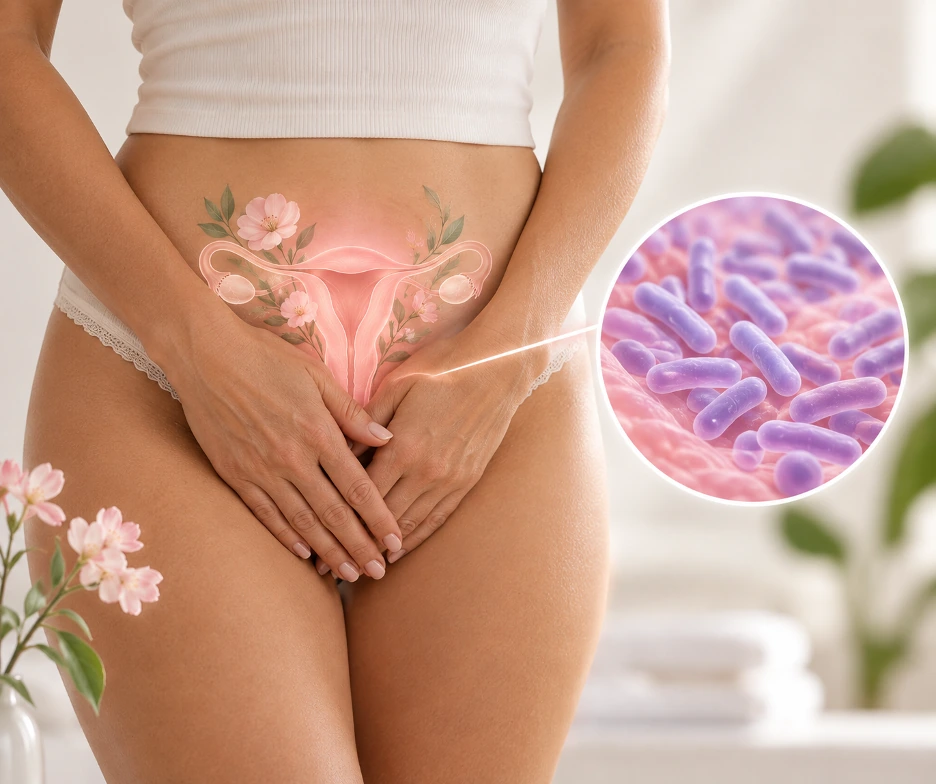
One of the most common misconceptions is that recurrent UTIs and bacterial vaginosis are some sort of “infection of the reproductive system” that can be treated with another round of antibiotics. In reality, these are hormonal conditions, and antibiotics only offer a temporary and limited form of relief.
Gut and Vagina Microbiome
The gut and vaginal microbiome are more similar than one might think. The two share 44% of bacterial species, and due to the proximity of the rectum and vagina, the bacteria from the gut can be easily transferred to the vagina. This includes Escherichia coli, one of the leading causes of UTIs. The connection between the two is so strong that researchers have named it the “gut-vagina axis,” which has bacterial migration, immune cell function, hormones, and bacterial metabolites.
In addition, the fact that UTIs often occur repeatedly is not just due to new bacteria from the gut infecting the bladder each time. Recent research suggests that the bladder has its own microbiome, which can contribute to the development of infection. Some bacteria can even hide inside cells in the bladder, waiting for the right time to exit and cause infection.
It is important to note that vaginal dysbiosis often plays a significant role in this process.
Estrogen and Vaginal Microbiome
Estrogen is the hormone that helps maintain the proper vaginal microbiome. First, estrogen helps the vaginal cells stimulate and store glycogen. This glycogen is then converted to lactic acid by lactobacilli, which helps maintain the acidic pH of the vagina and prevents the colonization of other bacteria. When estrogen levels drop, the vaginal lining becomes thinner, glycogen is no longer stored, and lactobacilli begin to perish. As a result, the pH rises, and bacteria such as Gardnerella vaginalis and uropathogenic E. coli begin to flourish causing bacterial vaginosis and UTIs respectively.
A number of studies have shown that reduced levels of Lactobacillus and increased levels of Gardnerella are associated with recurrent UTIs. Researchers have also found that Gardnerella vaginalis can adhere to the walls of the bladder, which can allow dormant E. coli reservoirs to be reactivated, leading to infection.
This discovery helps explain why some women are unable to overcome recurrent UTIs, since every new course of antibiotics simply suppresses lactobacilli, allowing uropathogenic E. coli to flourish.
Antibiotics and Microbiome
It is important to note that antibiotics should not be entirely abandoned in the treatment of recurrent UTIs. However, if a woman is faced with recurrent infections, antibiotic therapy should not be the only measure to combat them. Every new course of antibiotics suppresses both pathogenic and healthy bacteria, including lactobacilli, which can make the situation even more difficult.
The problem with antibiotic prophylaxis is that it can lead to the development of resistant strains of bacteria. For example, it has been found that after a month of continuous treatment with trimethoprim-sulfamethoxazole, resistance to this antibiotic can develop in 90% of bacteria isolated from urine and feces. In other words, women often end up in a vicious circle: the longer they take antibiotics, the greater the risk that the next course will be ineffective.
Vaginal Estrogen
The American Urological Association, European Association of Urology, American Urogynecologic Society, and American Geriatrics Society all recommend vaginal estrogen as the preferred hormone therapy for recurrent UTIs in hypoestrogenic peri- and postmenopausal women. This is one of the proven methods used to reduce the frequency of UTIs in these patients.
Several randomized controlled trials and a meta-analysis have confirmed that vaginal estrogen therapy reduces the recurrence of culture-confirmed UTIs, while oral estrogen has little or no effect.
More recently, a large observational study of more than 5,600 hypoestrogenic women has found that the number of UTIs decreased by an average of 51.9% per year after the initiation of vaginal estrogen therapy. In addition, nearly a third of women who received this treatment were completely free of UTIs the year after treatment began.
For women who require additional protection, methenamine hippurate is another effective option. Clinical trials have shown that this drug is non-inferior to continuous antibiotic prophylaxis in preventing UTIs, while reducing the development of resistant strains of bacteria.
The use of probiotics for the prevention and treatment of UTIs is controversial. Some research has shown that the use of vaginal probiotics containing Lactobacillus crispatus can reduce the number of UTIs by colonizing the vagina with beneficial bacteria. However, the results of these studies were inconsistent, and the American Urological Association does not recommend the routine use of probiotics due to insufficient evidence. It is noteworthy that some researchers have proposed combining vaginal estrogen with probiotics to achieve a synergistic effect. While there is no direct evidence of the benefits of this combination, it is entirely logical, since estrogen helps to restore the vaginal environment, while probiotics help to colonize it with beneficial bacteria.
Researchers are also looking at the role of the estrobolome – the collective term for the bacteria that regulate estrogen levels in the body. The hypothesis is that the estrobolome is involved in the development of dysbiosis in the vagina and gut during menopause, since changes in the hormonal system disrupt the balance of these microorganisms. This is another reason why menopause affects not only the vagina but also the entire urogenital system.
Conclusion
When faced with recurrent UTIs or bacterial vaginosis in postmenopausal patients, I try to look at the bigger picture. In most cases, the root of the problem is not pathogens but the low level of estrogen, which leads to a change in the vaginal microbiome. To restore the balance, a woman needs more than just antibiotics – she needs to renew the cells of the vaginal lining and allow lactobacilli to colonize the vagina.
The future of UTI prevention is individualized and focused on restoring the vaginal microbiome rather than suppressing it with antibiotics. For many menopausal women, this means using vaginal estrogen therapy. This approach not only helps to prevent UTIs but also helps to relieve menopausal symptoms such as dryness and itching. In addition, other methods of preventing UTIs can be used, the choice of which should be made individually for each patient.
References:
Anger J, Lee U, Ackerman AL, et al. Recurrent uncomplicated urinary tract infections in women: AUA/CUA/SUFU guideline. J Urol. 2019;202(2):282-289. doi:10.1097/JU.0000000000000296. The guideline has since been updated, with the 2025 update continuing to recommend vaginal estrogen for peri- and postmenopausal women with recurrent UTI when there is no contraindication.
Raz R, Stamm WE. A controlled trial of intravaginal estriol in postmenopausal women with recurrent urinary tract infections. N Engl J Med. 1993;329(11):753-756. doi:10.1056/NEJM199309093291102. This is the classic randomized trial showing both reduced recurrent UTI and restoration of vaginal lactobacilli with vaginal estriol.
Ferrante KL, Wasenda EJ, Jung CE, Adams-Piper ER, Lukacz ES. Vaginal estrogen for the prevention of recurrent urinary tract infection in postmenopausal women: a randomized clinical trial. Female Pelvic Med Reconstr Surg. 2021;27(2):112-117. doi:10.1097/SPV.0000000000000749.
Chen YY, Su TH, Lau HH. Estrogen for the prevention of recurrent urinary tract infections in postmenopausal women: a meta-analysis of randomized controlled trials. Int Urogynecol J. 2021;32(1):17-25. doi:10.1007/s00192-020-04397-z. This is particularly useful for your statement that vaginal estrogen reduces recurrent UTI whereas oral estrogen has not demonstrated the same benefit.
Stapleton AE. The vaginal microbiota and urinary tract infection. Microbiol Spectr. 2016;4(6). doi:10.1128/microbiolspec.UTI-0025-2016. This is an excellent reference for the estrogen → Lactobacillus → vaginal environment → UTI relationship and the increased vaginal colonization with E coli after menopause.
Jung C, Brubaker L. The etiology and management of recurrent urinary tract infections in postmenopausal women. Climacteric. 2019;22(3):242-249.
Harding C, Mossop H, Homer T, et al. Alternative to prophylactic antibiotics for the treatment of recurrent urinary tract infections in women: multicentre, open label, randomised, non-inferiority trial. BMJ. 2022;376:e068229. doi:10.1136/bmj-2021-0068229. This is the ALTAR trial supporting methenamine hippurate as a noninferior alternative to daily low-dose antibiotic prophylaxis for recurrent UTI