
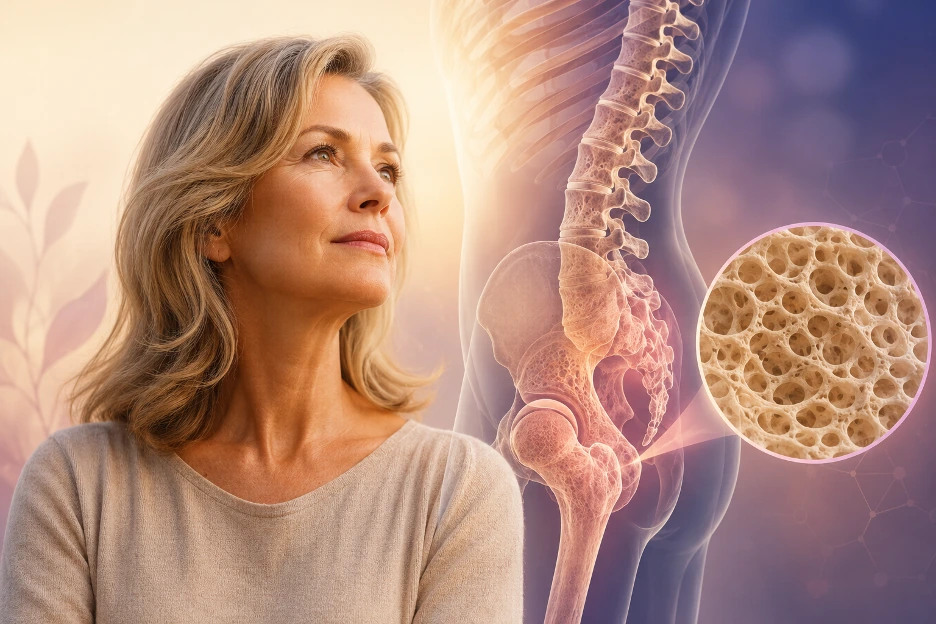
Bone health is one of the most under-recognized problems of menopause. Most women are worried about hot flashes and weight gain. However, the loss of bone mass that usually occurs during perimenopause continues to accelerate after menopause and can reach 2 to 2.5% annually around the final menstrual period. This loss accounts for a decrease in bone mineral density by nearly 50% compared to the period before menopause. In addition, by the time a woman knows she has osteoporosis, she has already lost a considerable amount of bone tissue. This is a serious public health problem since 20% of women over 50 years of age have osteoporosis, while another 40% have osteopenia. Moreover, 50% of women will suffer a fragility fracture, and one-third of women over 50 will suffer an osteoporotic fracture worldwide, resulting in a significant reduction in quality of life and even death in the case of hip fracture. One of the most common complications of osteoporosis is a hip fracture, since about 25% of people who have suffered it die within a year, and many of them lose their autonomy.
Osteoporosis is often asymptomatic until a fracture occurs, although there are various warning signs that should make a woman go to the doctor. However, women have comparatively little knowledge and understanding of their personal risks and frequently report inadequate counseling by their healthcare providers.
They significantly underestimate their risk of fracture because they do not consider many risk factors associated with osteoporosis. These include:
Previous fracture after age 50 increases the risk of subsequent fractures, with a wrist fracture being a predictor of hip fracture.History of parental hip fracture, low body weight, tobacco use, heavy alcohol consumption, premature menopause, rheumatoid arthritis, inflammatory bowel disease, celiac disease, diabetes mellitus, chronic kidney disease, hyperthyroidism, hyperparathyroidism, etc. Medications that can contribute to the development of osteoporosis are: long-acting glucocorticoids, aromatase inhibitors, proton pump inhibitors, selective serotonin reuptake inhibitors, antiepileptic drugs, excess thyroid hormone, drugs that enhance the effect of GABA, for example, benzodiazepines or opioids, which can lead to falls. The most important risk factor for hip fracture is falling, 90% of which occur after the age of 65. Preventive measures against falls are crucial, for example, walking exercises to strengthen the muscles and joints, vision checks, reducing the risk of slipping.
Prevention of osteoporosis is indeed possible, and there are several effective interventions. First of all, doctors recommend therapeutic physical culture, since clinical studies have shown that progressive resistance exercises combined with a choice of impact or weight-bearing physical activities most often have a positive effect on increasing bone mineral density. Such exercises should be done at least 150 minutes per week, and two or more times a week – training workouts to maintain muscle strength. In addition, to prevent osteoporosis, it is necessary to take calcium and vitamin D supplements, get rid of the harmful habits mentioned above, treat diseases that affect the hormonal balance and the absorption of minerals by the body, and provide the body with a balanced diet and a sufficient amount of protein.
Most women do not know that they should periodically visit a healthcare provider for a DXA scan after age 65 - or at a younger age if there are additional risk factors. Despite the availability of screening tests, few women get recommended to actually do them, and most who suffer a fragility fracture do not receive osteoporosis treatment.
Moreover, menopausal hormone therapy (MHT) is indicated for women with fractures of any severity: it reduces the risk of all-cause, clinical, and specific site fractures in postmenopausal women of any age with or without a history of fracture. Thus, for women who are candidates for MHT, this method is the only one proven to reduce the risk of fractures of all sites regardless of prior fracture and is indicated for the prevention of postmenopausal osteoporosis.
The Women’s Health Initiative showed that estrogen-containing drugs reduced the risk of clinical fractures, including vertebral, hip, and forearm fractures. In particular, estrogen plus progestin decreased the risk of clinical fractures by about 35% and hip fractures by 39%. In addition, meta-analyses of randomized trials confirm that MHT reduces the risk of vertebral fractures by 34% and hip fractures by 29%.
A promising direction in the fight against osteoporosis is the concept of the physiological threshold of estrogen. More than 30 years ago, scientists noticed that when blood estradiol levels exceed 60-90 pg/ml, markers of bone breakdown decrease. In addition, a 2026 comparative analysis of transdermal estradiol clinical trials and classic studies, such as KEEPS and ELITE, concluded that the optimal bone and cardiovascular function corresponds to serum estradiol levels of 60 pg/ml. MHT is prescribed considering the balance of benefits and risks for each patient, and the choice of dosage within the range of standard doses also remains open. Although discussions about the physiological level of estrogen are actively developing among menopause specialists, measuring estradiol levels continues to be an unproven practice.
To conclude, I want to emphasize that there is nothing inevitable about menopause-related bone loss. It is crucial to use the time before the first fracture to reduce the fracture risk. Therefore, women should view menopause as an opportunity to: assess overall fracture risk, optimize nutrition and exercise, identify secondary causes of bone loss, and decide whether to pursue pharmacologic options to reduce fracture risk. We cannot delay managing osteoporosis until the first fracture, as by then, the opportunity to prevent it will be lost.
References:
LeBoff MS, Greenspan SL, Insogna KL, et al. The clinician’s guide to prevention and treatment of osteoporosis. Osteoporos Int. 2022;33(10):2049-2102. doi:10.1007/s00198-021-05900-y.
US Preventive Services Task Force; Nicholson WK, Silverstein M, Wong JB, et al. Screening for osteoporosis to prevent fractures: US Preventive Services Task Force recommendation statement. JAMA. 2025;333(6):498-508. doi:10.1001/jama.2024.27154.
The 2022 Hormone Therapy Position Statement of The North American Menopause Society Advisory Panel. The 2022 hormone therapy position statement of The North American Menopause Society. Menopause. 2022;29(7):767-794. doi:10.1097/GME.0000000000002028.
Gartlehner G, Patel SV, Reddy S, et al. Hormone therapy for the primary prevention of chronic conditions in postmenopausal persons: updated evidence report and systematic review for the US Preventive Services Task Force. JAMA. 2022;328(17):1747-1765. doi:10.1001/jama.2022.18324.
US Preventive Services Task Force; Mangione CM, Barry MJ, Nicholson WK, et al. Hormone therapy for the primary prevention of chronic conditions in postmenopausal persons: US Preventive Services Task Force recommendation statement. JAMA. 2022;328(17):1740-1746. doi:10.1001/jama.2022.18625.
Cauley JA, Robbins J, Chen Z, et al; Women’s Health Initiative Investigators. Effects of estrogen plus progestin on risk of fracture and bone mineral density: the Women’s Health Initiative randomized trial. JAMA. 2003;290(13):1729-1738. doi:10.1001/jama.290.13.1729.
Jackson RD, Wactawski-Wende J, LaCroix AZ, et al; Women’s Health Initiative Investigators. Effects of conjugated equine estrogen on risk of fractures and BMD in postmenopausal women with hysterectomy: results from the Women’s Health Initiative randomized trial. J Bone Miner Res. 2006;21(6):817-828. doi:10.1359/jbmr.060312.
Zhu L, Jiang X, Sun Y, Shu W. Effect of hormone therapy on the risk of bone fractures: a systematic review and meta-analysis of randomized controlled trials. Menopause. 2016;23(4):461-470. doi:10.1097/GME.0000000000000519.
Shieh A, Greendale GA, Cauley JA, Karlamangla AS. The association between fast bone loss and incident fracture in postmenopausal women: a prospective study from the Study of Women’s Health Across the Nation. Osteoporos Int. 2021;32(1):57-65.
Greendale GA, Sowers M, Han W, et al. Bone mineral density loss in relation to the final menstrual period in a multiethnic cohort: results from the Study of Women’s Health Across the Nation (SWAN). J Bone Miner Res. 2012;27(1):111-118. doi:10.1002/jbmr.534.
Watson SL, Weeks BK, Weis LJ, Harding AT, Horan SA, Beck BR. High-intensity resistance and impact training improves bone mineral density and physical function in postmenopausal women with low bone mass: the LIFTMOR randomized controlled trial. J Bone Miner Res. 2018;33(2):211-220. doi:10.1002/jbmr.3284.
Howe TE, Shea B, Dawson LJ, et al. Exercise for preventing and treating osteoporosis in postmenopausal women. Cochrane Database Syst Rev. 2011;(7):CD000333. doi:10.1002/14651858.CD000333.pub2.
Cauley JA. Public health impact of osteoporosis. J Gerontol A Biol Sci Med Sci. 2013;68(10):1243-1251. doi:10.1093/gerona/glt093.
Cummings SR, Melton LJ. Epidemiology and outcomes of osteoporotic fractures. Lancet. 2002;359(9319):1761-1767. doi:10.1016/S0140-6736(02)08657-9.
Søgaard AJ, Holvik K, Omsland TK, et al. Age and sex differences in body mass index as a predictor of hip fracture: a NOREPOS study. Am J Epidemiol. 2016;184(7):510-519. doi:10.1093/aje/kww011.
Rossouw JE, Anderson GL, Prentice RL, et al; Writing Group for the Women’s Health Initiative Investigators. Risks and benefits of estrogen plus progestin in healthy postmenopausal women: principal results from the Women’s Health Initiative randomized controlled trial. JAMA. 2002;288(3):321-333. doi:10.1001/jama.288.3.321.
Prestwood KM, Pilbeam CC, Burleson JA, et al. The short term effects of conjugated estrogen on bone turnover in older women. J Clin Endocrinol Metab. 1994;79(2):366-371. doi:10.1210/jcem.79.2.8045951.
Optimizing estradiol serum levels for optimal skeletal and cardiovascular health during transdermal menopausal hormone therapy. Gynecol Endocrinol. Published online 2026. doi:10.1080/09513590.2026.2694742.