

I was recently quoted by Yahoo Health about the growing phenomenon known as "meat ick" among patients taking GLP-1 medications. While the name is informal, the underlying biology is fascinating—and it may explain why patients tell me every week, "Food just doesn't taste the same anymore."
The phenomenon called “meat ick” is a sensation, experienced by some patients on GLP-1 agonists (e.g., semaglutide and tirzepatide), where certain foods previously enjoyed by them, e.g., red meat, chicken, eggs, etc., taste bad or are insipid – or worse – make them feel ill. I hear reports of “meat ick” from my patients all the time – while they may not always be exact words used, they describe things like food tasting disgusting, being unable to finish a meal, or a general distaste for certain foods they used to enjoy.
“Meat ick” is definitely not a formal diagnosis, but it is a real side effect that many patients can expect when on GLP-1 agonists. The pharmacological mechanism is simple: reducing appetite by decreasing hunger center activation in the hypothalamus and slowing gastric emptying. These combined effects lead to enhanced feelings of fullness after meals, reduced food reward, and even stronger nausea when exposed to certain foods. The last two phenomena are key reasons why “meat ick” happens. Namely, certain foods become unpleasant due to either being intensely rewarding (high-calorie foods like red meat) or causing increased nausea (foods that are harder to digest or have a stronger smell).
There is also some evidence that GLP-1 agonists decrease motivation for highly palatable foods by modulating mesolimbic pathways, specifically the ventral tegmental area (VTA) and nucleus accumbens (NAc). It is well-known that these brain regions are responsible for food reward processing and motivation for food. The rewarding effects of food are largely driven by dopamine release in the VTA-NAc pathway. This neural circuitry is partially controlled by GLP-1 receptors (in addition to being expressed in the hypothalamus), and activation of these receptors by GLP-1 agonists has been shown to attenuate dopamine signaling in the VTA and NAc. In essence, this means that certain foods become less desirable when on GLP-1 agonists – patients feel like they “used to taste good,” but “now just taste like food.” This is corroborated by fMRI evidence – compared to placebo, GLP-1 agonists decreased BOLD responses in the orbitofrontal cortex, insula, amygdala, and striatum to food images, with a significant reduction in the response to high-calorie items. This decreased neural response to food likely underlies the reduced cravings and “food noise” in patients on GLP-1 agonists.
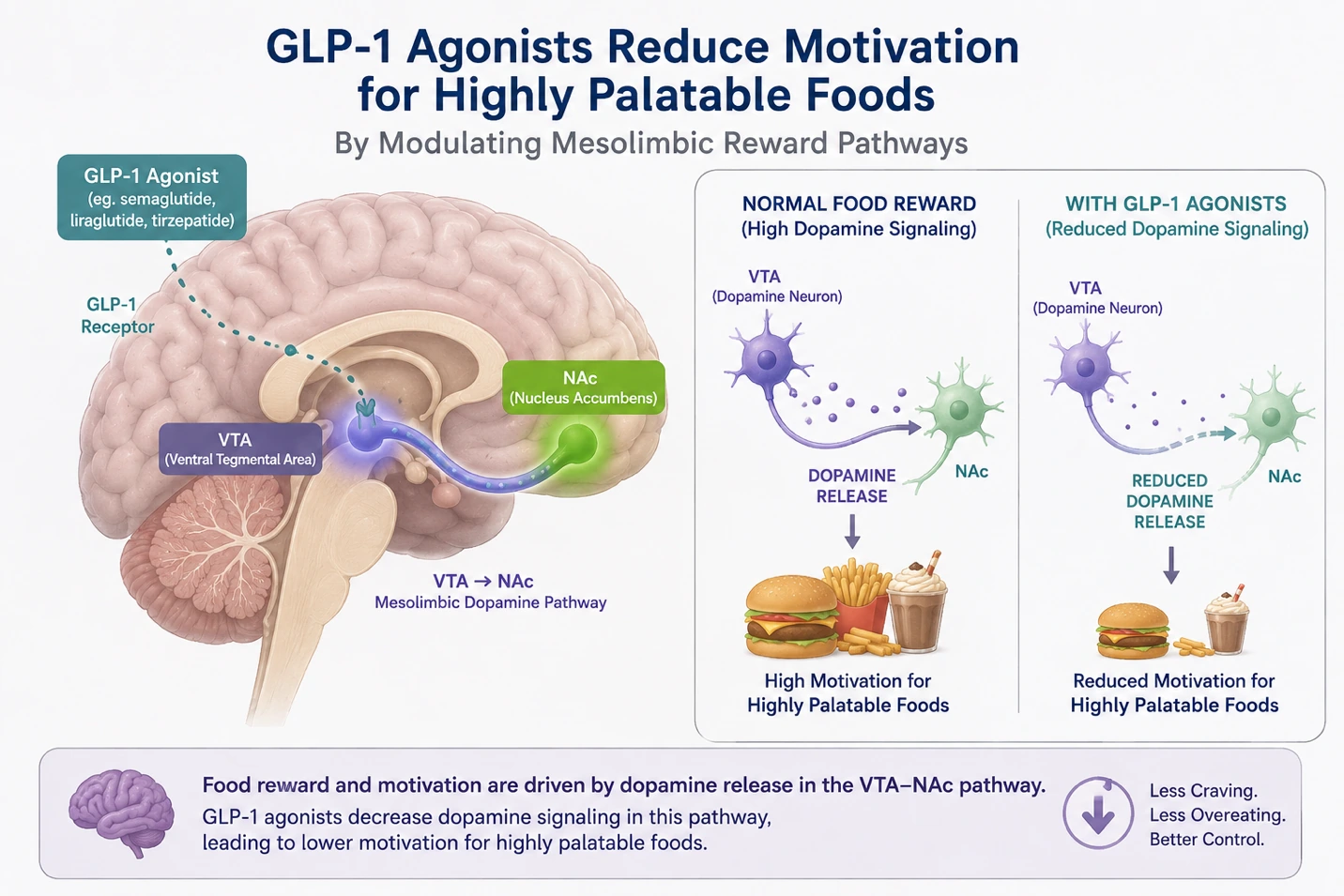
It goes beyond simply “reducing the reward of food,” however – several of the mechanisms mentioned above can lead to an overall decrease in food desirability, making patients feel like they “cant stand the smell of food.” A likely culprit here is slowed gastric emptying that GLP-1 agonists are infamous for – patients feel full for a longer period of time, but also experience increased nausea when eating highly palatable or fatty foods. The body then associates these foods with feeling ill (conditioned taste aversion), and patients find themselves avoiding certain types of food altogether. This is especially true for red meat, which is harder to digest and produces stronger smells.
Additionally, there may be a direct effect of GLP-1 agonists on the sense of smell and taste – patients report that food “just tastes different” while on these medications. This, coupled with the reduced dopamine signaling described above, most likely contributes to the “meat ick” phenomenon. It is important for patients to realize that “meat ick” is not permanent – while they may not feel obligated to eat foods that make them feel ill, they should try to meet their protein requirements in other ways.
Some practical advice for patients who experience “meat ick” might be to trial protein sources that are lower in fat or a pure protein (Greek yogurt/cottage cheese), protein drinks, egg white or substitutes, tofu, tempeh, lentils, beans and other legumes, protein oatmeal or other protein enriched cereals and protein smoothies. Also, patients can trial eating “cold” protein if tolerated (e.g., yogurt instead of meat dishes) may also be better tolerated by patients who experience “meat ick”. Furthermore, eating smaller, more frequent meals and avoiding greasy foods is likely to reduce nausea and food aversion in general
An important consideration for patients on GLP-1 agonists is the maintenance of lean muscle mass while on a calorie-restricted diet. Patients on GLP-1 agonists are prone to losing muscle mass if they do not consume enough protein, especially if they are sedentary. I recommend approximately 1.2-1.6 g/kg of protein per day, depending on the patient’s kidney function and overall activity level, in combination with resistance training if possible. There is a growing body of literature that emphasizes the importance of adequate protein intake on weight loss while on GLP-1 agonists.
The good news is that “meat ick” is usually temporary – most patients get used to the decreased food reward and can tolerate a wider variety of foods over time, or when the dosage is increased (in cases where higher doses of semaglutide or tirzepatide are used). The overall goal is to maintain protein intake while avoiding foods that cause nausea and food aversion.
Curious how Yahoo Health covered this topic? Read the article featuring my expert commentary here: Yahoo Health Article "Meat Ick"
References:
Alhadeff AL, Rupprecht LE, Hayes MR. GLP-1 neurons in the nucleus of the solitary tract project directly to the ventral tegmental area and nucleus accumbens to control for food intake. Endocrinology. 2012;153(2):647-658. doi:10.1210/en.2011-1443
Blundell J, Finlayson G, Axelsen M, et al. Effects of once-weekly semaglutide on appetite, energy intake, control of eating, food preference, and body weight in subjects with obesity. Diabetes Obes Metab. 2017;19(9):1242-1251. doi:10.1111/dom.12932
Farr OM, Upadhyay J, Rutagengwa C, et al. Longer duration treatment with liraglutide decreases body mass index and activates brain regions involved in inhibitory control in response to food cues: a randomized, placebo-controlled trial. Diabetes Care. 2016;39(10):1743-1751. doi:10.2337/dc16-0454
Hayes MR, Schmidt HD. GLP-1 influences food and drug reward. Physiol Behav. 2016;162:213-220. doi:10.1016/j.physbeh.2016.03.038
Jastreboff AM, Aronne LJ, Ahmad NN, et al. Tirzepatide once weekly for the treatment of obesity. N Engl J Med. 2022;387(3):205-216. doi:10.1056/NEJMoa2206038
Müller TD, Finan B, Bloom SR, et al. Glucagon-like peptide 1 (GLP-1). Nat Rev Dis Primers. 2019;5(1):1-19. doi:10.1038/s41572-019-0081-y
Secher A, Jelsing J, Baquero AF, et al. The arcuate nucleus mediates GLP-1 receptor agonist liraglutide-dependent weight loss. J Clin Invest. 2014;124(10):4473-4488. doi:10.1172/JCI75276
van Bloemendaal L, Veltman DJ, Ten Kulve JS, et al. GLP-1 receptor activation modulates appetite- and reward-related brain areas in humans. Diabetes Obes Metab. 2014;16(9):863-866. doi:10.1111/dom.12281